


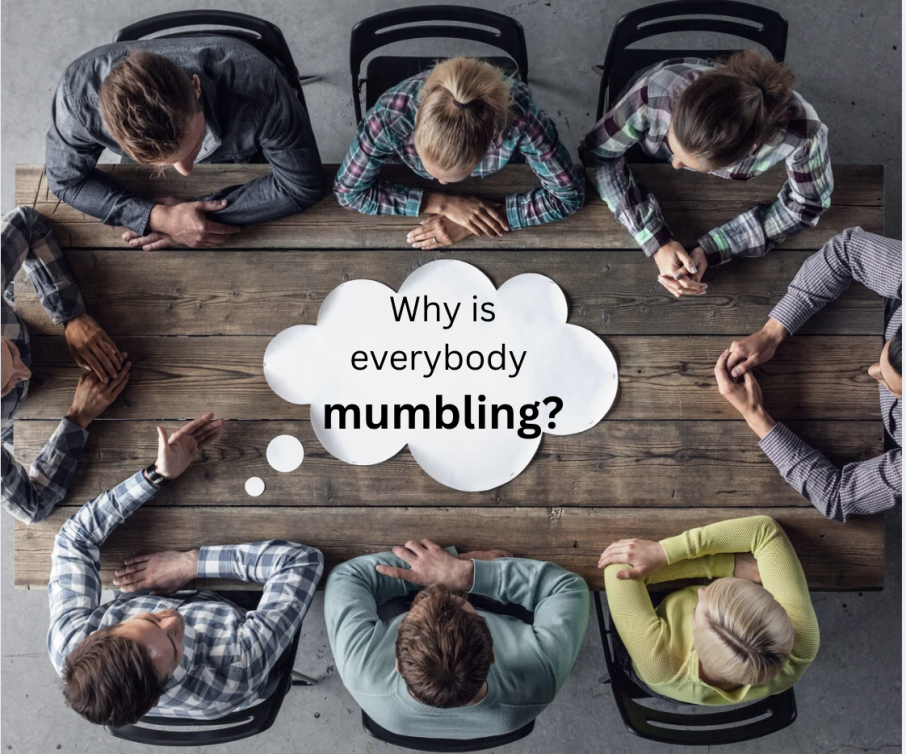
We recently dusted off one of our favorite articles. While it might be a few years old, the message is just as true today as the day it was written. Technology has advanced, but human nature hasn’t! We still see clients every week who are convinced their hearing is fine—it’s just that the rest of the world has suddenly started mumbling. Read on for a funny, relatable, and incredibly accurate look at the reality of age-related hearing loss.
The following is an abbreviated adaptation of an article by Susan Seliger: “The New York Times”.
While visiting my parents recently, I overheard a conversation between them that went something like this.
Mom, in the dining room: “Did you take out the trash?”
Dad, in the living room: “I have plenty of cash. What do you need money for?”
“What? I don’t want any money.”
“Why did you ask for it?”
“What did you say? You’re mumbling again.”
I felt as if I was in the middle of that Abbott and Costello routine. The only difference is that after a while, the daily misunderstandings and frustrations of having to repeat yourself become a lot less funny. When I suggested to my parents that they might want to get their hearing tested, their first reaction (after exasperated sighs) was that they didn’t want to be bothered. Turns out, they’ve got a lot of company.
“The average person has been having trouble hearing for 7 to 10 years before they come in — they say it’s only been a few months, but we’ve found it’s years,” said Dr. Eric Hagberg, an audiologist in Youngstown, Ohio, and president of the Academy of Doctors of Audiology. Of the 26.7 million people over age 50 with a hearing impairment, only one in seven, a meager 14 percent, use a hearing aid, said Dr. Frank Lin, assistant professor of otolaryngology and epidemiology at Johns Hopkins University. “If you think you have a hearing loss, you probably do,” he said.
Why so much resistance to getting hearing impairment diagnosed and treated? First, denial. Many older adults just don’t think they have a problem. The person with a hearing problem is often the last to notice it, because the change comes on gradually over years and starts subtly. Adults with hearing loss typically say, “I can hear just fine if people would just stop mumbling.” They’re half right. It isn’t that they can’t hear — they can. The problem is that they can’t understand. The first clue to a hearing impairment is mixing up consonants. Age-related hearing loss often occurs in the high-frequency ranges that, in English, tend to carry the consonants.
Many older adults think it’s normal to lose some hearing ability. If a majority of older people have hearing loss – and 55 percent of those over age 70 do — then it can’t be that harmful, right? Wrong. Because the ear plays a role in balance, hearing loss can lead to falls. “Even mild hearing loss can triple the risk of falling,” said Dr. Lin, citing his own research as well as a study of Finnish twins. And then there is the mysterious link to dementia. Some studies have suggested that mild hearing loss is linked to a doubling of dementia risk, and that moderate hearing loss can triple it. With severe hearing loss, the risk can be five times as high, according to Dr. Lin’s 2011 study in Archives of Neurology and a report last month in The Journal of the American Medical Association. It is possible that hearing loss leads to social isolation, itself a risk factor for dementia, said Dr. Lin. In addition, few people realize that delayed treatment may make hearing loss worse. “If you don’t use it, you’ll lose it,” said Dr. Remensnyder. “I have a retired nurse, age 90, who has lived alone with no auditory stimulation for years. She doesn’t understand 50 percent of the words, and I can’t reverse that now.”
Even among the enlightened, hearing aids still carry a stigma. “Men think, ‘It’s a sign of weakness,’ and women think, ‘It’s showing my age,’ ” said Dr. Hagberg. Anyone over 60 remembers when the words “deaf and dumb” were always uttered together – and “dumb” was not used to mean “mute.” Vanity, too, is still a deterrent. But that may be receding now that new hearing aids are smaller and less visible than ever. Besides, it’s increasingly commonplace to see young and old alike walking around with devices plugged into their ears.
“I tell patients who deny they have a problem, even after testing, to go home and pay attention to every time they say, ‘What?’ or they miss the punchline on TV or ask people to repeat something,” said Dr. Hagberg. Primary care doctors often fail to test for hearing loss. It helps to line up a team of hearing care professionals who are patient and passionate about working with the elderly. Interview certified audiologists (listed here and here) until you find one you like.
A majority of those who finally get hearing aids — and do the necessary follow-up visits with an audiologist — experience positive results.
“It’s thrilling,” said Barb Merry, age 68, from Appleton, Wis., describing life after she got hearing aids — especially the improvement in watching TV. She uses an additional device in the TV area that operates much the way metal induction loops installed in many theaters, concert halls and public institutions do – transmitting sound directly into a telecoil in her hearing aids.
“When I used to watch ‘Downton Abbey,’ that English series, my understanding was maybe 40 percent at best — I thought the problem was their English accents,” Mrs. Merry said. “But now I understand 95 percent. Only 5 percent is the English thing.”
She continued, “I want to talk to everyone I know and say, ‘Get over the shyness about hearing aids – life can be better.’
If you believe yourself or a loved one is suffering from hearing loss, please call Comprehensive Ear & Hearing for a FREE Hearing Evaluation.